


We’ve been right where you are. You get the positive pregnancy test, your mind starts to race with all things baby, you head down the prenatal vitamin rabbit hole and find yourself looking up folic acid, choline, DHA… gummies, and capsules, and powders, oh my!
You may even start to wonder if your prenatal vitamin even has all of the things you actually need. Should you be supplementing with something else or is there one prenatal to rule them all?
The most important question is, of course, what should be in a prenatal vitamin? And should you stick with the same one your entire pregnancy?
Let’s talk about it.
What Is a Prenatal Vitamin?
Prenatal vitamins are your daily supplement specifically formulated with key ingredients like folic acid or folate, vitamin D, and DHA to support both maternal and fetal development. Ideally, you begin taking them at least one to three months before trying to conceive and continue to take them throughout the postpartum period.
Prenatal vitamins can come in many forms, from gummies to capsules to powders, even liquids, which can be helpful if you have a particularly hard time swallowing pills.
Trying to conceive? Read How to Get Pregnant: 10 Things to Do When You’re Trying to Conceive.
As a pregnant woman, your nutritional needs will change over time to support your growing baby, so it’s important that your prenatal vitamin helps to fill those gaps.
What Should You Look for in a Prenatal Vitamin?
It’s no secret that the prenatal vitamin choices can be overwhelming— all different brands, different flavors, different formats, and different ingredients. And don’t get us started on those labels that feel like trying to decode alphabet soup.
But whether you’re well-versed in vitamin speak or new to the prenatal game, there are a few essential ingredients you’re likely to spot in most of them:
Folate/Folic Acid
One of the most important ingredients in a prenatal vitamin is folate, which your body needs to make new cells. It’s found naturally in foods like leafy greens and beans, and appears in supplements as folic acid (a synthetic form) or methylfolate (L-5-MTHF, the active form your body uses).
More than one-third of pregnant women don’t get enough folate from food alone, leaving a gap during the exact window when the neural tube closes. The American College of Obstetricians & Gynecologists (ACOG) recommends a daily prenatal with at least 400 mcg of folic acid to help support neural tube development. On labels, folate is listed in mcg DFE (dietary folate equivalents), so 400 mcg of folic acid appears as 680 mcg DFE.
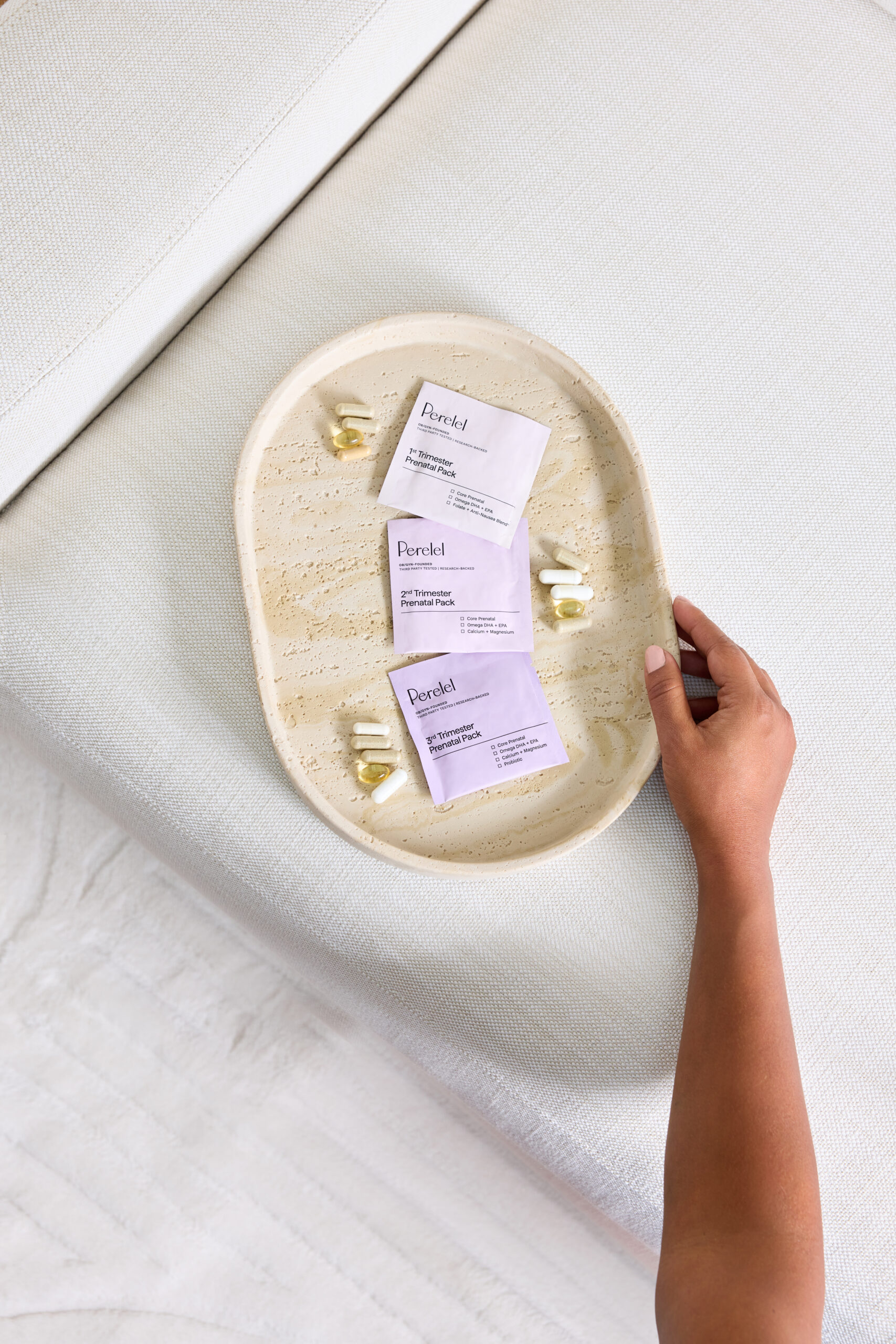
Perelel, an OB/GYN-founded company, takes a stage adjusted approach to their vitamins, and adjusts their folate dosages by stage. In their 1st Trimester Prenatal Pack, an added 825 mcg DFE brings the total to 1,525 mcg DFE to support healthy neural tube development during the early weeks, when the neural tube forms. The Second and Third Trimester Packs return to the Core Prenatal’s 700 mcg DFE to continue supporting cell growth and red blood cell production.
Iron
Your body uses iron to produce the extra blood needed for both you and your baby during pregnancy. Because your blood volume increases during pregnancy, you need 27mg of iron a day, about 50% more than before pregnancy.
DHA/Omega-3s
DHA is an omega-3 fatty acid that supports your baby’s growing brain, eyes, and nervous system. EPA, another omega-3 often paired with DHA, is left out of many prenatal supplements. Omega-3s are a type of fat naturally found in many kinds of fish and shellfish, including salmon and sardines.
ACOG recommends eating two to three servings of low-mercury fish or shellfish per week before and during pregnancy. Many pregnant women fall short of that, so a prenatal with omega-3s can help fill the gap.
Choline
Choline is another essential building block for your baby’s brain development that can be found in chicken, beef, eggs, milk, soy, and peanuts. Experts suggest pregnant women get 450 mg of choline per day during pregnancy, yet research suggests about 95% of pregnant women fall short. Many prenatal vitamins contain no choline, so be sure to check the label.
Perelel’s Prenatal Packs include 120 mg of choline. For those who need more, depending on their diet, Perelel’s Choline Boost adds 550 mg per serving to help meet daily needs.
Iodine
Much like folate, iodine supports your baby’s brain and nerve development, as well as healthy thyroid function. Both you and your baby are making thyroid hormones during pregnancy which results in an increased nutritional need of 220 mcg of iodine per day. During breastfeeding, that number ticks up even more to 290 mcg per day, according to the Mayo Clinic.
Vitamin D
Vitamin D works alongside calcium to help fetal teeth and bone development. Vitamin D is also key for healthy skin and eyesight and can be found in foods like egg yolks, fatty fish, breakfast cereals, and fortified milk.
Perelel says up to 50% of pregnant women have insufficient Vitamin D levels, even in sunny climates. What’s more, baby’s skeletal development speeds up in the third trimester and calcium demands increase. Without supplementation, it’s possible that not enough Vitamin D would be consumed to ensure that calcium is absorbed and put to use.
Perelel’s own Trimester Prenatal Packs include 2,000 IU (50 mcg) of Vitamin D to support calcium absorption and fetal bone development.
What to Look for on the Labels
The next time you pick up a bottle of prenatal vitamins, don’t just take their word for it when the packaging reads “Contains folate!” You’ll want to make sure you’re checking the label for the specific formulation and ingredient amounts.
Certain prenatal vitamins may contain different forms of key nutrients, while others may not contain enough of the recommended daily amounts of nutrients like choline or iodine.
And since individual nutrient needs can vary, choosing a prenatal vitamin is a great place to loop in your doctor who can advise what will make the most sense for you given your history.
Do Your Prenatal Vitamin Needs Change by Trimester?
This is the question that ultimately helped lead to the creation of Perelel. After co-founder Victoria Thain Gioia’s daughter was born with a cleft lip, despite Victoria taking the vitamins and following the prenatal guidance she knew to follow, she began digging deeper into the roles different nutrients play throughout pregnancy.
Meanwhile, co-founder Alex Taylor had spent her own pregnancy researching how nutritional needs change from one stage to the next and piecing together vitamins from multiple sources to adjust her routine along the way.
Together, they saw a gap in the one-size-fits-all approach to prenatal vitamins and set out to create something different. Along with OB/GYN Dr. Banafsheh Bayati as Perelel’s Medical Co-Founder, they developed a stage-specific approach to maternal health, with formulations designed to evolve from preconception through pregnancy, postpartum, and beyond.
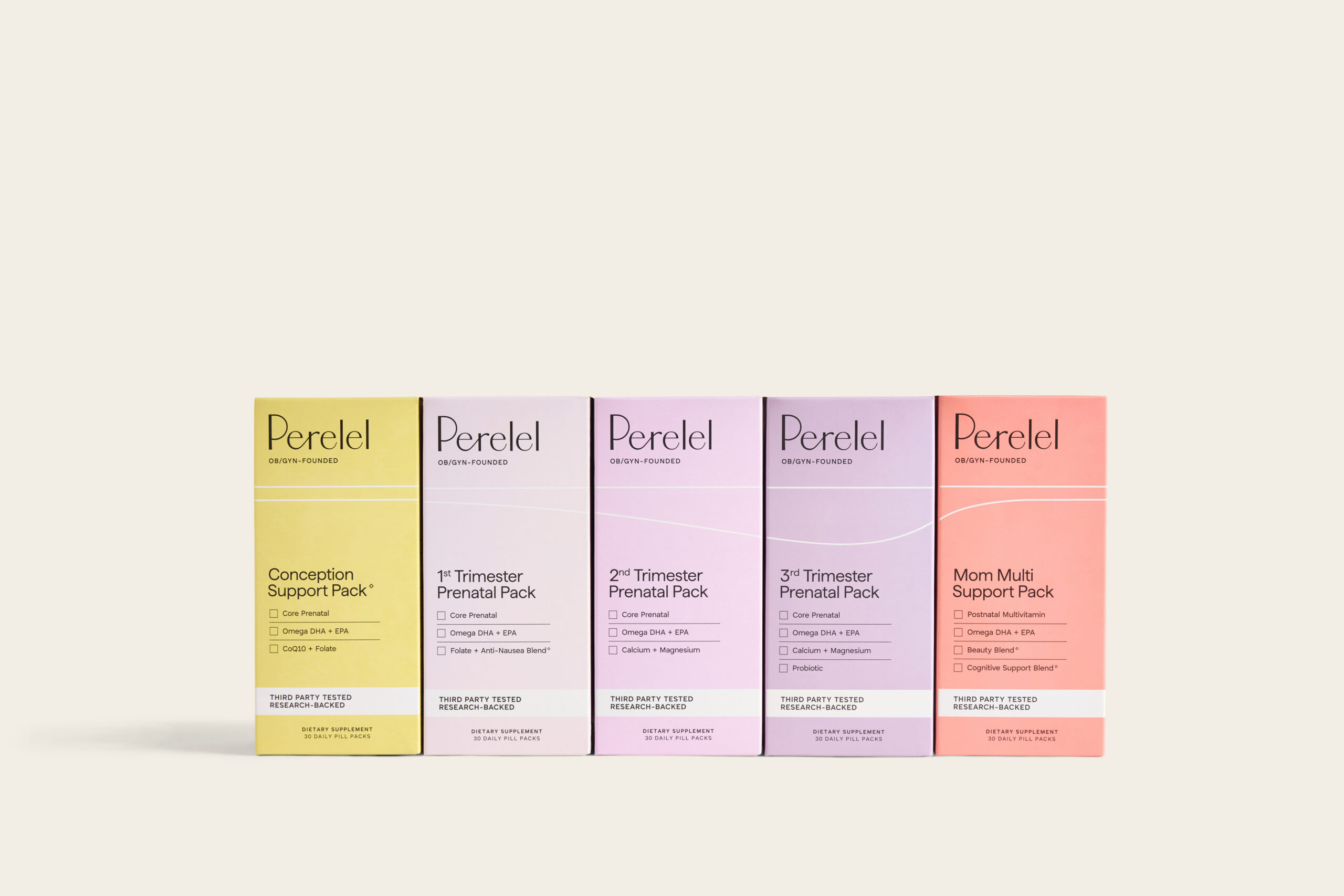
The formulations in Perelel’s Trimester Prenatal Packs provide foundational nutrients throughout pregnancy, including DHA, EPA, and choline to support baby’s brain development, with additional nutrients adjusted to support the needs of each stage.
First Trimester
In your first trimester (AKA the first 13 weeks of pregnancy), the neural tube forms the brain and spinal cord, the heart begins beating and pumping blood, and digestive systems begin to function.
Perelel 1st Trimester Prenatal Pack
The 1st Trimester Prenatal Pack supports this critical window of early development, with DHA and choline for baby’s growing brain, calcium and magnesium for growing bones, bioavailable iron that’s better absorbed and gentler on your stomach for oxygen delivery and mom’s healthy blood volume, and iodine to support healthy thyroid development. The prenatal vitamin pack also includes a clinically studied blend of vitamin B6 and ginger to reduce occasional nausea for mom.
Second Trimester
In your second trimester (AKA weeks 14-27 of pregnancy), your baby’s brain continues to grow, bones begin to harden, hearing develops, eyes move into position, and they begin to kick, roll, and swallow.
Perelel 2nd Trimester Prenatal Pack
The 2nd Trimester Prenatal Pack includes calcium and magnesium for bone development and mom’s muscle and nerve function, iron for oxygen delivery and mom’s expanding blood volume, and iodine to support healthy thyroid development.
Third Trimester
In your third trimester (AKA weeks 28-40 of pregnancy), your baby is gaining weight and storing fat, the lungs mature, practice breathing movements begin, and iron stores are transferred from you to your baby.
Perelel 3rd Trimester Prenatal Pack
The 3rd Trimester Prenatal Pack includes Omega DHA for brain development during this period of rapid growth, iron to build the reserves baby needs for birth, calcium and magnesium to maintain mom’s bone health and support muscle relaxation, as well as a 12-strain probiotic for immune function, gut, and the vaginal microbiome to help prepare for birth.
Look for Quality Standards
What’s inside your prenatal vitamin is important, but so is how it’s made. Consider this your reminder to look beyond the label as you compare prenatal vitamins and consider the brand’s testing and manufacturing standards too.
Third-party testing
Has the product been independently tested rather than the brand making its own quality claims?
Contaminant testing
Does the company screen for things you don’t want in a prenatal vitamin, like heavy metals, pesticides, and other contaminants?
Manufacturing standards
Does the company disclose where and how the products are manufactured and what quality standards those facilities follow?
Transparency
Can you find information about testing and quality on the company’s site?
Perelel, for instance, third-party tests its products for heavy metals and microbials, and has received the Clean Label Project Purity Award for their Prenatal Packs. The company also says its products are manufactured in the United States in FDA registered and inspected, cGMP-certified facilities and tested through ISO-accredited labs.
Choose a Prenatal Vitamin You Can Actually Take
Of course, none of this research into the best prenatal vitamins even matters if they sit untouched in your medicine cabinet.
You’ll want to make sure you choose a prenatal you will actually take every day. Since pregnancy can come with its own share of nausea, food aversions, sensitivity to smells, and the inability to swallow anything larger than a blueberry, the form of the vitamins is key.
Prenatal vitamins can come in capsules, softgels, gummies, powders, even liquids. Ask yourself which feels the most doable to take every day, something you’ll stick with. Does the daily serving—whether it’s one capsule or several—feel realistic to you? Do you know how you’ll incorporate it into your daily routine?

Perelel takes some of the guesswork out of the daily routine by packaging its prenatals into individual daily packs, so you’re not sorting through bottles every morning. The brand also offers a Gentle Prenatal Powder as an alternative to traditional capsules if you’re having a particularly hard time with pills during pregnancy, giving you another option for keeping up with your prenatal routine.
And if you find that a prenatal vitamin doesn’t agree with you, it’s best to talk to your doctor rather than abandoning prenatals altogether.
Talk to Your Doctor
Even with a prenatal vitamin checklist in hand, there’s no substitute for a conversation with your doctor. Your nutritional needs may look different depending on your diet, health history, medications, lab results, deficiencies, or other factors specific to your pregnancy.
Next time you meet, you might like to ask:
Is there anything I should look for in a prenatal vitamin?
Do I need additional supplementation beyond what’s included in my prenatal vitamin?
Are there nutrients I’m already getting enough of through my diet?
Should anything change based on my health history?
Your prenatal vitamin is just one part of your overall pregnancy nutrition plan and one that you can continue to revisit with your provider as you and your baby move through each stage of pregnancy.
Choosing the right prenatal vitamins doesn’t have to mean standing in the supplement aisle Googling every ingredient on the label.
Now you know which core nutrients to watch for, the amounts that flex depending on your stage of pregnancy, why quality and testing play an important role, and to look for something you’ll consistently take.
Your body changes every trimester and your prenatal vitamins can do the same. Perelel’s stage-specific formulations make it easy to support your growing body and baby every step of the way.
This post is sponsored by Perelel.

This post contains affiliate links. When you buy through links on our site, we may earn a commission at no extra cost to you.
This post contains affiliate links. When you buy through links on our site, we may earn a commission at no extra cost to you.